Piano lessons at Lake Wörthsee for children and adults
From your first chord to a piece of your own – learn to play the piano. Online lessons are also available for adults.
Arrange a trial lesson
From your first chord to a piece of your own – learn to play the piano. Online lessons are also available for adults.
Arrange a trial lesson
At the piano, one person can be a whole orchestra. Melody, accompaniment, bass: everything is at your fingertips. Just a few simple chords are enough to make music. Yet the possibilities of sound and technique are almost limitless. That still fascinates me today.
Your child does not need to be able to read to start learning the piano. Young children learn best by copying. They listen, watch my fingers and then play what they have seen and heard.
Over the years, I have developed my own approach to teaching music reading, using sight and touch. Most children are surprised at how quickly they learn to read music this way. It works just as well for adults, too.
At the beginning, I bring parents on board. When you know what matters, you can give your child much better support during the week. I teach both children and adults in German or English.
Most adults who come to me want one thing above all: to make music themselves, and soon. That is why we often start with chords. You can use them to accompany your own singing or play a pop song you love. Before long, you will be playing your first complete piece.
Some people learned the piano as children and stopped at some point. When you return, it will feel different from those earlier lessons. No pressure, no compulsory programme. We play the music you really want to play.
I know this from my own experience: after years of waiting, I was finally allowed to start the piano at twelve. I was so motivated that I made enormous progress in a short time. Many adults bring that same curiosity when they begin.
The decision to take up the piano often comes when life is changing. The children are past the most demanding years, retirement is beginning, or you finally have time for yourself again. We are happy to talk about that during the lesson, too.
Morning appointments are also available. If you live further away or only have time during your lunch break, you can learn with me online, in English as well.
Many beginners press too hard and raise their shoulders without noticing. That is why we get the seat height and distance from the instrument right from the start. It may sound simple, but it makes a huge difference to your shoulders, arms and neck. We take breaks and do a few gentle stretches along the way. In time, you will learn to notice tension yourself.
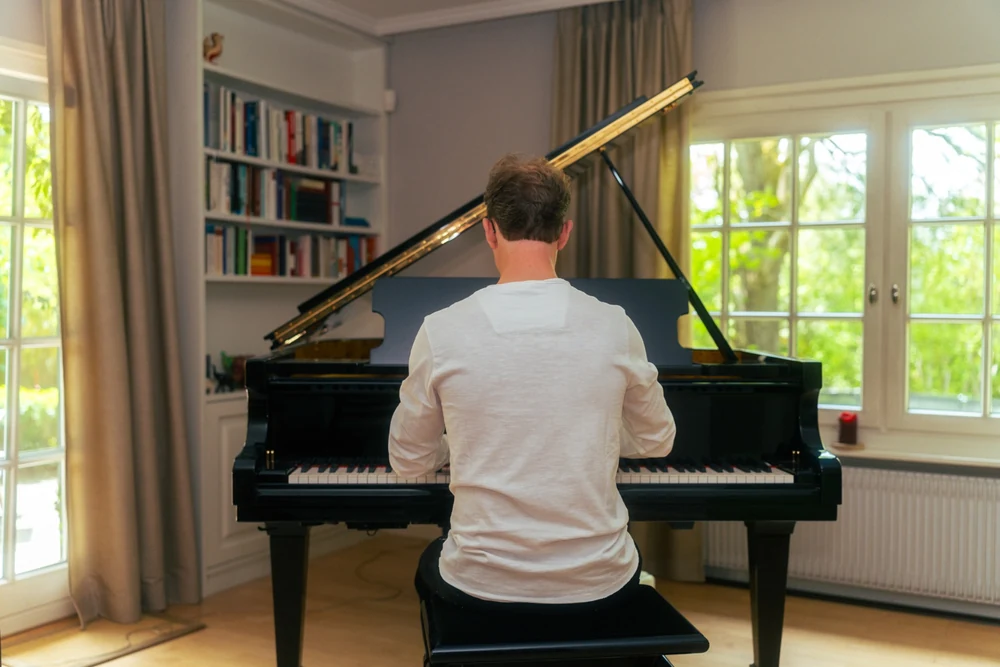
Training as a school music teacher involves a very practical approach to the piano: accompanying songs, playing with a band, sight-reading and improvising. That has shaped my teaching. I give classical music a thorough grounding and teach it with enthusiasm. But if you would rather accompany your favourite songs or improvise freely, we are just as happy to do that. There is no need to choose one or the other.
Every lesson starts with a warm-up.
Then you play what you have practised during the week, and we continue working on it together.
Next, we add something new: a piece, a chord, or an idea for improvisation.
At the end, we write in your practice diary what to work on before the next lesson. That way, you know exactly what to do at home.
A good digital piano is often better than a poor acoustic piano. What matters is that the keys are weighted and respond to your touch. Otherwise, you will not learn to play loudly and softly. A digital piano has practical advantages, too: you can turn the volume down or play with headphones, and connect it to apps. In some homes, it is the better solution to begin with.
For children, there is no need to start with an expensive instrument. You can begin more affordably and upgrade later if the enthusiasm lasts. But I will also be honest: a beautiful sound and a good keyboard make you want to play. If you wish, I can advise you when buying an instrument.
Next step
The trial lesson is a real teaching session, so there is a charge. I will be happy to tell you the prices on request.
From age 6. Your child does not need to be able to read yet.
Yes. I teach you to read music in a very clear way that works quickly.
For practising, yes. To begin with, a digital piano with weighted keys is sufficient.
Many adults play their first proper piece after a short time.
Yes, if you wish, I prepare students for “Jugend musiziert”. It is never compulsory with me.
The trial lesson is a real lesson: 30 minutes for children and 60 minutes for adults. I see where you are and we work straight away on something concrete: a first piece, a technique or a passage that currently concerns you. This means you take something away from the lesson and experience how I teach.
Yes, it is charged. I will be happy to tell you the prices on request.
Yes, for adults throughout Germany and in English internationally as well.
In person in the Wörthsee region, and online for adults as well. We will agree the exact location personally.